Actualization of approaches to development design under conditions of digital transformation of the socio-economic environment
DOI:
https://doi.org/10.32347/2707-501x.2022.49(2).201-212Keywords:
development, digital transformation, information modeling, urban environment, BIM, intelligent systems, sustainable development, urban studiesAbstract
This work explores contemporary transformational processes that influence the field of development design amid the digitalization of the socio-economic environment. Special attention is given to the rethinking of traditional approaches to the initiation, planning, and implementation of development projects, taking into account changes in consumer behavior, the growing role of data, the necessity for sustainability, and the need for rapid adaptation to new contexts.
A systemic approach is proposed for updating development strategies, considering the influence of intelligent platforms, analytical tools, and modeling technologies (BIM, GIS, digital twins) at all stages of the project cycle. It is determined that a key objective is to build an adaptive digital ecosystem in which management decisions are made based on real-time data, and risks are anticipated through scenario modeling. The need for a transition to the concept of dynamic project management is justified, where planning is not separated from execution but occurs within an interactive environment with constant goal and priority updates.
The study examines the new roles of the developer as a coordinator of digital flows and an integrator of social, economic, and technological changes—no longer simply an investor or client. This requires a rethinking of competencies within development structures, which must combine analytical, design, and managerial skills within a unified digital space. Special attention is devoted to changes in approaches to forming urban concepts, designing functionally mixed environments, assessing environmental neutrality, and analyzing an object’s life cycle. A methodological framework is proposed for the digital reconfiguration of development models, considering sustainability factors, stakeholder involvement, and urban evolution.
Conceptual principles are also formulated for building a new paradigm of development design—based on flexibility, dynamism, integration with digital services, and the management of information flows.
References
Prykhodchenko V. S. Standardization of Integration Approaches in Construction Information Systems // Systems of Control, Navigation and Communication. – 2021. – No. 2(64). – P. 35–41. – [Electronic resource]. – Access mode: https://journals.nupp.edu.ua
Brynjolfsson E., McAfee A. The Second Machine Age: Work, Progress, and Prosperity in a Time of Brilliant Technologies. – Book. – New York: W.W. Norton & Company, 2014. – 306 p. – [Electronic resource]. – Access mode: https://wwnorton.com/books/9780393350647
Porter M., Heppelmann J. How Smart, Connected Products Are Transforming Competition. – Article. – Harvard Business Review, 2014, No. 92(11). P. 64–88. [Electron]. – Access mode: https://lnk.ua/k94y7g1VM
KPMG. Real Estate Innovation Overview. – Analytical Report. – Amsterdam: KPMG Global PropTech Survey, 2019. – 54 p. – [Electronic resource]. – Access mode: https://lnk.ua/YdNYyrkNM
Deloitte. 2021 Commercial Real Estate Outlook: A faster path to recovery. – Report. – New York: Deloitte Insights, 2021. – 36 p. – [Electronic resource]. – URL: https://lnk.ua/gk4xzw6Vy
Gomber P., Kauffman R. J., Parker C., Weber B. On the Fintech Revolution: Interpreting the Forces of Innovation, Disruption, and Transformation in Financial Services. – Article. – Journal of Management Information Systems, 2018, Vol. 35, No. 1. – P. 220–265. – [Electronic resource]. – URL: https://lnk.ua/GAVMAvvVo
Yu. A. Involving Applied Advantages of BIM-Technologies in the Methodology and Practice of Forming the Project Life Cycle within State Target Programs Implemented by the Construction Cluster // Ekonomika ta derzhava. – 2019. No. 2. [Electron]. URL: https://ekonomika.com.ua (sample access)
Olanipekun A. O. Facilitating Digital Transformation in Construction — A Systematic Review of the Current State of the Art. – [Electronic resource]. – Frontiers in Built Environment, 2021. – DOI: 10.3389/fbuil.2021.660758
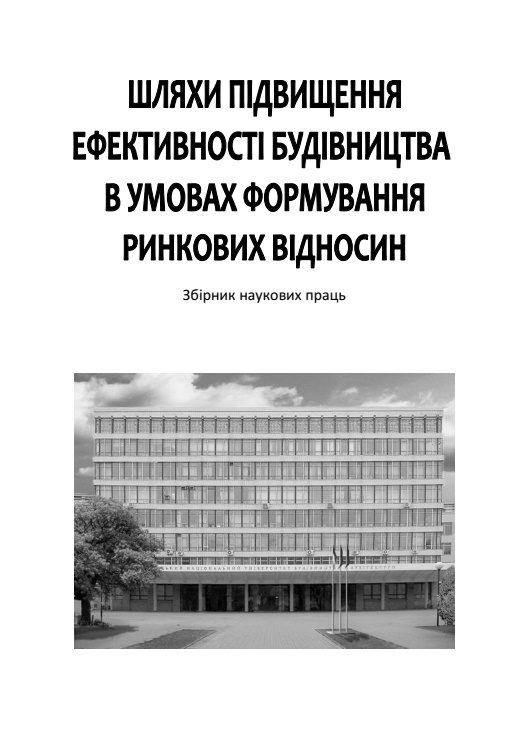
Ryzhakova H. M., Chupryna Yu. A. Formation of the Construction Cluster in the Format of State Investment Target Programs // Collected Scientific Works “Ways to Improve the Efficiency of Construction in the Context of Market Relations”. – Issue 40. – 2019. – P. 19–24.
Succar B., Kassem M. Macro-BIM Adoption: Conceptual Structures. – Article. – Automation in Construction, 2015, Vol. 57. – P. 64–79. – [Electronic resource]. – Access mode: https://doi.org/10.1016/j.autcon.2015.04.018
Downloads
Published
How to Cite
Issue
Section
License

This work is licensed under a Creative Commons Attribution 4.0 International License.
Authors who publish with this journal agree to the following terms:
- Authors retain copyright and grant the journal right of first publication with the work simultaneously licensed under a Creative Commons Attribution License that allows others to share the work with an acknowledgement of the work's authorship and initial publication in this journal.
- Authors are able to enter into separate, additional contractual arrangements for the non-exclusive distribution of the journal's published version of the work (e.g., post it to an institutional repository or publish it in a book), with an acknowledgement of its initial publication in this journal.
- Authors are permitted and encouraged to post their work online (e.g., in institutional repositories or on their website) prior to and during the submission process, as it can lead to productive exchanges, as well as earlier and greater citation of published work (See The Effect of Open Access).