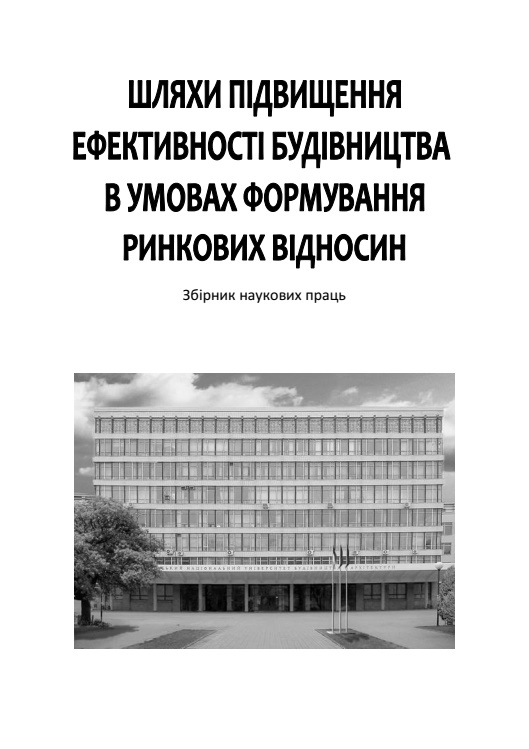
Problems of reconstruction of residential buildings of different periods of construction
DOI:
https://doi.org/10.32347/2707-501x.2022.49(1).92-97Keywords:
reconstruction, energy efficiency and energy saving, emergency situation, energy audit, modernization, restoration, overhaul, housing stockAbstract
Currently, the reconstruction of the housing stock and industrial enterprises of Ukraine is of great importance, which is due to the state of emergency of many buildings in connection with the military actions of the aggressor. The term of operation of the means of production is due to the physical and moral wear of machines and mechanisms. The houses and buildings in which the means of production are located and function also age physically and morally, although this aging occurs more slowly than the means of production.Further postponement of restoration work may lead to the need for their demolition. The Verkhovna Rada Committee supported the bill on the comprehensive reconstruction of obsolete housing estates. This was reported by the Ministry of Development of Communities and Territories of Ukraine. The Committee on Environmental Policy and Nature Management of the Verkhovna Rada supported the bill on the comprehensive reconstruction of obsolete housing estates. measures during the overhaul.One of the main directions of solving this problem is reconstruction. Based on the analysis of literature articles, the article considers the issue of reconstruction of existing residential buildings in Europe in order to improve energy saving and energy efficiency. Examples of modernization of residential buildings over the past few years are considered. The tendencies of the process of reconstruction of the housing stock of European countries are analyzed and singled out. The peculiarities of restoration works are analyzed, and also the necessity of reconstruction of buildings, different periods of construction is substantiated. The accumulated experience of foreign implementation of projects in existing buildings allows us to say that the reconstruction leads to a reduction in energy consumption, emissions, increased reliability and improved appearance.
References
Механізм фінансування заходів енергоефективності в Україні. URL: https://www.minregion.gov.ua/wp-content/uploads/2017/03/Mehanizmi-finansuvannya-zahodiv-energoefektivnosti-v-Ukrai--ni.pdf
Афанасьев А.А., Матвеев Е.П. Реконструкция жилых зданий. Ч. II. Технологии реконструкции жилых зданий и застройки. М., 2008. URL: http://dom.esco.agency/wp-content/uploads/2019/05/51_art72.pdf
Олюха В. Г. Оптимізація капітального будівництва: господарсько-правові проблеми: монографія. Київ: Центр учбової літератури, 2015. 302 с.
Бузырев В. В. Реновация жилых домов как важный фактор увеличения жизненного цикла жилищного фонда в регионе. Проблемы современной экономики, 2012. URL: http://www.meconomy.ru/art.php?nArtId=4353
Gebäudesanierung „Passivhaus im Bestand“ in Ludwigshafen. Mundenheim Messung und Beurteilung der energetischen Sanierungserfolge. PASSIV HAUS INSTITUT Dr. Wolfgang Feist. URL: https://passiv.de/downloads/05_sanierung_phib.pdf
Delovaya, A. (2020). Issues of Reconstruction of Residential Buildings of Early Construction Periods. Bulletin of Science and Practice. 6. Pp. 291-294. 10.33619/2414-2948/54/37
Lisha A., Deng Y., Min R. Structural reconstruction design and performance simulation analysis of old buildings based on BIM. International Journal of Low-Carbon Technologies, Vol. 13, Issue 3, September 2018. Pp. 255–259. https://doi.org/10.1093/ijlct/cty024
Новосад І.Г. Специфічні прийоми реконструкції типових житлових будинків 1970-1980-х років. Управління розвитком складних систем. 2016. № 26. С. 146–152
Лисенко Ю.В., Шапран Д.О., Болсунова Н.А. Умови і стратегічні напрями реконструкції житлового фонду в Україні. URL: http://www.chtei-knteu.cv.ua/herald/content/download/archive/2012/v1/1-2012-67.pdf