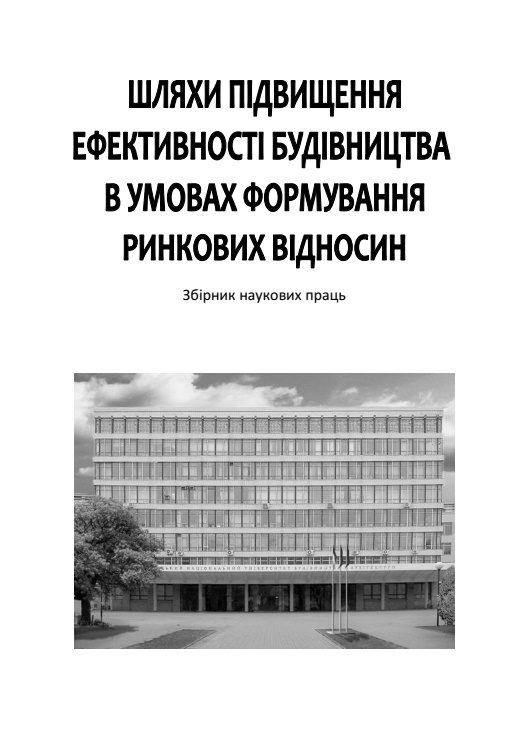
Imperatives of managing the economic security of development companies
DOI:
https://doi.org/10.32347/2707-501x.2022.49(2).46-60Keywords:
economic security, development company, construction market, risks, management, digitalization, investment projects, strategic sustainabilityAbstract
The article examines the imperatives of managing the economic security of development companies in the context of the transformation of the economic environment, increasing risks and decreasing predictability of business processes in the field of construction development. It is substantiated that the economic security of such companies is not only a system of protection against external threats, but also a key tool for strategic stability, financial balance and support for investment attractiveness. The article analyzes modern challenges that affect the stability of development activities, in particular: political and regulatory instability, fluctuations in the capital market, inflationary processes, logistics failures and resource shortages.
A conceptual vision of economic security as a multi-level system is formulated, including financial, investment, legal, personnel, information and operational components. The feasibility of using risk-oriented management models based on systematic monitoring of critical indicators, digital analytics and scenario modeling of threats is substantiated. Particular attention is paid to the role of digital tools — ERP systems, BIM modeling, project management systems (PMS), as well as blockchain and artificial intelligence technologies — in ensuring transparency, controllability and predictability of development processes.
As a result of the study, an author’s model of an integrated economic security management system for a development company was proposed, which allows increasing the efficiency of risk identification, optimizing internal processes, protecting critical assets and ensuring the stability of the implementation of investment and construction projects in the medium and long term. The conclusion was made about the need to develop regulatory and methodological support and implement economic and legal mechanisms to support economic security in development at the institutional level.
References
Гойко А.Ф., Сорокіна Л.В., Скакун В.А. Емпіричне оцінювання безпеки економічного розвитку підприємств будівництва: європейський аспект. Шляхи підвищення ефективності будівництва, 2019. № 40. С.3-18..
Економетричний інструментарій управління фінансовою безпекою підприємств будівництва: [моногр.] За наук. Ред. Д.е.н., проф. Л.В. Сорокіної, к.е.н., проф. А.Ф. Гойко ¬ К.: КНУБА, 2017. 405 с.
Tytok V., Bolila N., Ryzhakov D., Pokolenko V., Fedun I. CALS–Technology as a Basis of Creating Modules for Assessment of Construction Products Quality, Regulation of Organizational, Technological and Business Processes of Stakeholders of Construction Industry Under the Conditions of Cyclical and Seasonal Variations. International Journal of Advanced Trends in Computer Science and Engineering. Volume 10, No.1, January – February 2021, рр. 271- 276.
Stetsenko S., Sorokina L., Izmailova K., Bielienkova O., Tytok V., Emelianova O. Model of a Company Competitiveness Control by Means of Artificial Intelligence Tools. International Journal of Emerging Trends in Engineering Research. Volume 9. No. 2, February 2021, рр. 60- 147
Любенко Н.М., Герасименко Е.С. (2014). Удосконалення механізму управління фінансовою стійкістю підприємства. Формування ринкових відносин в Україні. № 6. С. 128-132.
Бєлєнкова О.Ю. Стратегія та механізми забезпечення конкурентоспроможності будівельних підприємств на основі моделі сталого розвитку: монографія. Київ: Ліра-К, 2020. 512 с.
Боліла Н.В., Цифра Т.Ю., Шевченко Ю. (2020). Ефективне використання оборотних коштів будівельного підприємства як фактор економічної безпеки. Шляхи підвищення ефективності будівництва в умовах формування ринкових відносин. Випуск 44 (економічний). С.174-182.
Стеценко С. П. Закономірності формування мезоекономічного рівня економічної безпеки. Ефективна економіка, 2013. (11) http://www.economy.nayka.com.ua/?op=1&z=2495.
Stetsenko S., Sorokina L., Goiko A., Tsyfra T., Bolila N. Cals-model for forming the anti-crisis potential of construction enterprises, Scientific Journal of Astana IT University, 2020. Vol. 4, pp. 49-57. https://doi.org/10.37943/AITU.2020.80.41.006.
Ізмайлова К.В., Боліла Н.В. Моделі прогнозування втрати фінансової стійкості як складова системи економічної безпеки підрядних будівельних підприємств. Шляхи підвищення ефективності будівництва в умовах формування ринкових відносин, 2018. Вип. 38. С. 225-232..
Боліла Н.В., Гусарова Л.В. (2019). Класифікація та систематизація загроз економічній безпеці будівельних підприємств. Шляхи підвищення ефективності будівництва в умовах формування ринкових відносин. Вип. 40, економічний. С. 344-346.
Гусарова Л. В. Екологічний компонент економічної безпеки як чинник сталого розвитку підприємств будівництва / Л. В. Гусарова, Н. В. Боліла // Науковий погляд: економіка та управління. – 2020. - №2 (68). – С. 121 – 124.
Bielienkova O., Stetsenko S., Sorokina L., Molodid O., Bolila N. System of preventive аction of construction enterprises on the basis of identification of anticrisis potential Scientific Journal of Astana IT University №3 2020 рр. 15-27.
Гойко А. Ф.,Сорокіна Л. В.,Скакун В. А. Оптимізація управління бізнес-процесами підприємств в умовах економічної кризи. Актуальні проблеми економіки. 2009. № 8. C. 58–66.
Сорокіна Л. В. Діагностика й регулювання стрибків економічного розвитку підприємства. Актуальні проблеми економіки. 2007. № 2. С. 93–100.
Ястремський О. І. Міжгалузева шахівниця невизначеності та її застосування: прогнозування, економічна політика, фіскальний ризик, загальна рівновага. Кібернетика і системний аналіз. 2019. № 3. C. 28–35.
Ястремський O. І. Порівняльний аналіз інституційної складової добробуту націй. Фінанси України. 2018. № 1. С. 62–71.