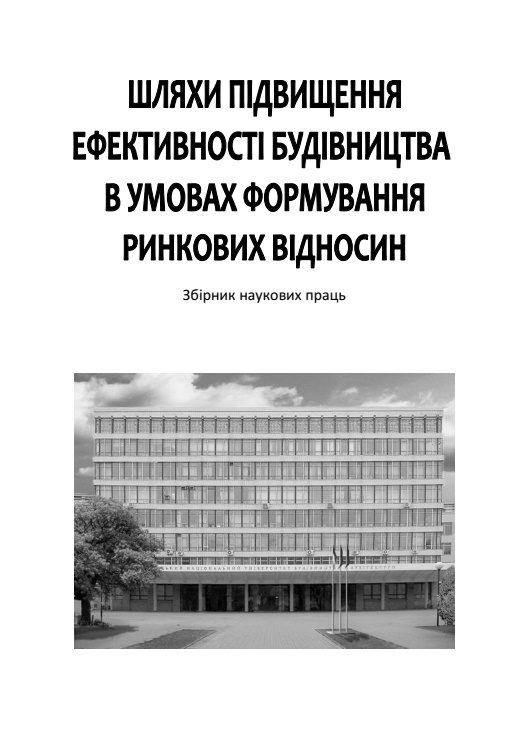
Business process reengineering as a factor of integrated economic resilience growth in developer structures throughout the enterprise life cycle
DOI:
https://doi.org/10.32347/2707-501x.2022.49(2).181-189Keywords:
business process reengineering, economic resilience, developer structures, construction development, enterprise life cycle, digital transformation, project attribution, management efficiency, business optimization, BIM technologies, ERP systems, strategic renewal, change managementAbstract
The article presents a methodology for evaluating business process reengineering (BPR) projects in construction developer structures, taking into account the phases of their life cycle, industry specifics, and multilevel stakeholder interaction. A conceptual and analytical approach to the attribution of reengineering projects is proposed, based on four key criteria: the level of transformation complexity, functional coverage, impact on cost-time parameters, and long-term efficiency potential. It is substantiated that under current conditions of high environmental dynamics and economic digitalization, BPR is no longer merely an optimization tool but is transforming into a comprehensive concept of strategic renewal aimed at achieving integrated enterprise resilience.
The proposed matrix model provides a structured assessment of the alignment of reengineering initiatives with key management parameters: complexity, scope, time-cost impact, and expected effectiveness. The research results confirm that effective attribution of BPR projects enables the identification of the most relevant areas of intervention in the developer's organizational structure, the justified ranking of transformational initiatives, and improved decision-making quality. It is demonstrated that BPR implementation should be differentiated according to the enterprise life cycle phase – from project initiation to modernization or decommissioning. Special attention is given to the role of digital technologies (including BIM, ERP, and digital twin systems) as catalysts for reengineering that enhance the flexibility and adaptability of business processes. The generalization of Ukrainian scholars' contributions has expanded the analytical framework of the study and supported the development of comprehensive, digitally oriented models for managing resilient developer structures in the construction industry.
References
Hammer, M. (1990). Reengineering work: Don't automate, obliterate. Harvard Business Review, 68(4), 104–112.
Hammer, M., & Champy, J. (1993). Reengineering the corporation: A manifesto for business revolution. Harper Business. 223 р.
Marchuk T., Ryzhakov D., Ryzhakova G. and Stetsenko S. (2017). Identification of the basic elements of the innovation-analytical platform for energy efficiency in project financing. Investment Management and Financial Innovations, 14(4), 12-20. doi:10.21511/imfi.14(4).2017.02
Honcharenko, T., Borodavka, Y., Ryzhakova, G., Ryzhakov, D., Savenko, V., & Polosenko, O. (2021). Method for representing spatial information of topological relations based on a multidimensional data model. ARPN Journal of Engineering and Applied Sciences, 16(7), 802-809.
Tormosov, R., Chupryna, I., Ryzhakova, G., Pokolenko, V., Prykhodko, D., Faizullin, A. (2021). Establishment of the rational economic and analytical basis for projects in different sectors for their integration into the targeted diversified program for sustainable energy development. 2021 IEEE Inter-national Conference on Smart Information Systems and Technologies pp. 1-9.
Nikolaiev V.P., Hryhorovskyi P.Ye., Khyzhniak V.O., Ryzhakova G.M., Bielienkova O.Yu., Molodid O.S. Technical and economic aspects of real estate properties: collective monograph. Lviv-Toruń: Liha-Pres, 2019. 124 p.
Bind V., Kucherenko O., Chupryna Kh., Chupryna Yu., Horbach M., Petrukha S. Vartisno-inzhynirynhovi komponenty poperedzhennia ekonomichnykh destruktsii v diialnosti uchasnykiv proektiv budivelnoho developmentu. Upravlinnia rozvytkom skladnykh system. 2021. №45. S. 121–130.
Ryzhakova, G., Pokolenko, V., Omirbayev, S., Novykova, I., Bielienkova, O., & Kapustian, M. (2022, March). Modern structuring of project financing solutions in construction. In 2022 International Conference on Smart Information Systems and Technologies (SIST). IEEE.
Tugai O.A., Hryhorovskyi P.Ye., Khyzhniak V.O., Stetsenko S.P., Bielienkova O.Yu., Molodid О.S., Chernyshev D.O. Organizational and technological, economic quality control aspects in the construction industry: collective monograph. Lviv-Toruń: Liha-Pres, 2019. 136 p.
Honcharenko T., Chupryna Y., Ivakhnenko I., Tsyfra T., Zinchenco M. “Reengineering of the Construction Companies Based on BIM-technology.” International Journal of Emerging Trends in Engineering Research, 2020, vol. 8. №8, http://www. warse.org/IJETER/static/pdf/file/ijeter22882020.pdf.
Bielienkova, O., Stetsenko, S., Oliferuk, S., Sapiga, P., Horbach, M., & Toxanov, S. (2021, April). Conceptual model for assessing the competitiveness of the enterprise based on fuzzy logic: social and resource factors. In 2021 IEEE International Conference on Smart Information Systems and Technologies (SIST) (pp. 1-5). IEEE.
Chernyshev, D., Khomenko, O., Ryzhakov, D., Dikiy, O., & Petrukha, S. (2020). Innovative technology for management tools of commercial real estate in construction. International Journal of Emerging Trends in Engineering Research, 8(9), 4967-4973.