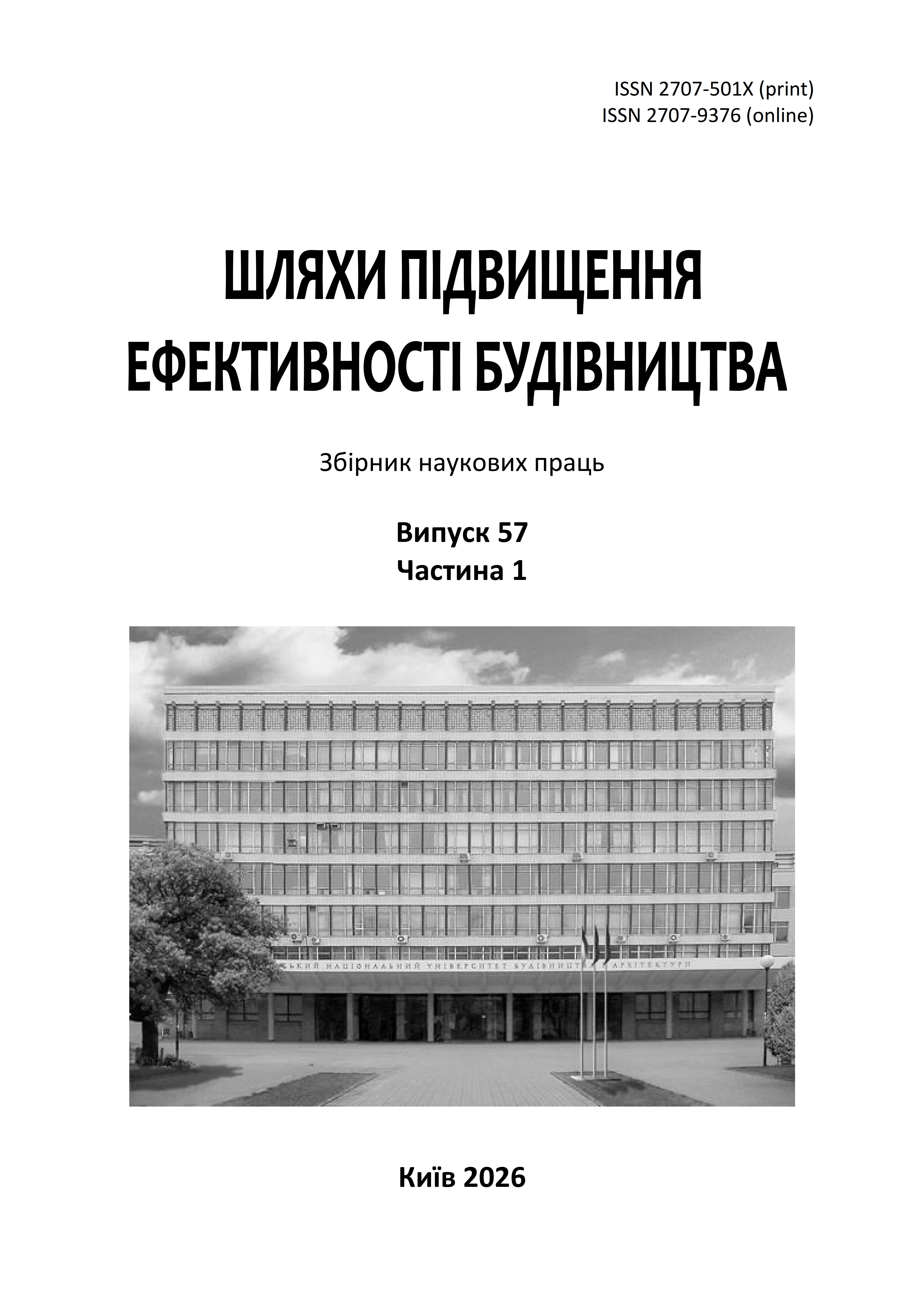
Analysis of the selection of possible solutions to reduce energy demand and costs of thermal modernization measures for building no. 4 of the national university “Zaporizhzhia Polytechnic”
DOI:
https://doi.org/10.32347/2707-501x.2026.57(1).223-234Keywords:
thermal modernization, energy certification, heating energy demand, building envelope, infiltration, individual heating substation, heat recovery, DSTU 9190:2022, organizational and technological methodologies, BIM/VDC, Lean ConstructionAbstract
The article presents an analysis of technical and organizational-technological solutions aimed at reducing the energy demand of the educational building No. 4 of Zaporizhzhia Polytechnic National University (64 Universytetska Street, Zaporizhzhia). The relevance of the study is обусловed by the significant deviation of the actual thermal performance characteristics of the building envelope from the minimum requirements of Ukrainian State Building Codes (DBN), as well as by the high integral energy consumption indicators typical of buildings constructed under outdated standards, as noted in both domestic and international research. The purpose of the study is to substantiate the rational selection of a set of thermal modernization measures based on a comparative analysis of their energy performance and organizational-economic feasibility, taking into account phased implementation without interrupting the educational process.
The initial building parameters were adopted according to the energy certification results and calculation materials: conditioned area – 6545.11 m², heated area – 5950.10 m², total volume – 24,114.97 m³, heated volume – 17,938.68 m³; the building was assigned energy efficiency class G. The thermal performance analysis of the building envelope revealed critically low values of reduced thermal resistance: for external walls (1605.115 m²) R = 0.291 m²·K/W with a required value of 3.5 m²·K/W; for the combined roof (1794.65 m²) R = 0.611 m²·K/W with a required value of 6.0 m²·K/W; for the slab above the unheated basement (544.6 m²) R = 0.387 m²·K/W with a required value of 4.0 m²·K/W; for glazed structures (1476.237 m²) R = 0.543 m²·K/W with a required value of 0.7 m²·K/W. The calculation of heat loss components and annual heating energy demand was performed in accordance with DSTU 9190:2022, distinguishing transmission and ventilation components, which made it possible to identify priority directions for energy demand reduction and justify the effectiveness of modernization packages. The following thermal modernization options were considered: façade insulation with 200 mm mineral wool, roof insulation of 300 mm, insulation of the slab above the basement, joint sealing and infiltration reduction, modernization of glazing systems, installation of an individual heating substation (IHS) with weather-compensated control and hydraulic balancing, and application of heat recovery systems. It was demonstrated that the greatest impact on reducing energy demand is achieved through comprehensive envelope modernization combined with engineering system upgrades and consumption management.
Additionally, the feasibility of applying modern organizational and technological methodologies to reduce cost risks and indirect expenses was substantiated, including Lean/LPS, BIM/VDC coordination with clash detection, and industrialized (modular) retrofit approaches. These methods increase schedule and budget predictability and support phased implementation of measures. The obtained results can be used in the development of thermal modernization programs for educational buildings, preparation of energy passports, and design solutions for the reconstruction of public buildings in line with sustainable development requirements.
References
Maksymov A., Kyrylov I., Chynchyk A. Thermomodernization of the housing fund on the basis of sustainable development: stages and directions. Building Production, 2025, 78, 94-102. https://doi.org/10.36750/2524-2555.78.94-102
Пашинський В.А., Настоящий В.А., Пашинський М.В., Богатирьов Д.В. Вплив підвищення нормативних вимог на рівень теплової надійності та втрати тепла через стіни й покриття житлових і громадських будівель. Центральноукраїнський науковий вісник. Технічні науки, 2024, 9(40), Ч. I, 64–74. https://doi.org/10.32515/2664-262X.2024.9(40).1.64-74
Maksymov А., Lysytsia N., Podoynitsyn S. Institutional development of the thermometernization market in the focus of main stakeholders. Building Production, 2024, 77, 18-25. https://doi.org/10.36750/2524-2555.77.18-25
Grigorovitch M., Vlad G., Yulzary S., Gal E. Advancing Energy Efficiency in Educational Buildings: A Case Study on Sustainable Retrofitting and Management Strategies. Applied Sciences, 2025, 5(20), Article 10867. https://doi.org/10.3390/app152010867
Бєлєнкова О., Коваль О. Цільові пріоритети та формалізовані показники реалізації концепції життєвого циклу об’єктів будівництва під час проектного фінансування програм відновлення житла. Будівельне виробництво, 2025, 78, 117-124. https://doi.org/10.36750/2524-2555.78.117-124
Череднікова О., Гузик Д., Мілейковський В., Харченко А., Соснін А., Чередніков М. Термомодернізація та удосконалення інженерних систем корпусу Ф Національного університету “Полтавська політехніка імені Юрія Кондратюка”. Вентиляція, освітлення та теплогазопостачання, 2025, 52, 32–46. https://doi.org/10.32347/2409-2606.2025.52.32-46
Бондаренко А., Юрченко Є., Коваль О., Коваль А. Обґрунтування методу визначення повітропроникності будівель. Вентиляція, освітлення та теплогазопостачання, 2024, 48, 40–49. https://doi.org/10.32347/2409-2606.2024.48.40-49
Кізєєв М., Новицька О., Кравченко Н., Проценко С. Аналіз заходів з підвищення енергоефективності навчальних корпусів національного університету водного господарства та природокористування. Вентиляція, освітлення та теплогазопостачання, 2024, 46, 77–88. https://doi.org/10.32347/2409-2606.2023.46.77-88
Гасімов А.Ф., Мамедов Н.Я., Акбарова С.М., Фейзієва Г Г. Проблеми енергоефективності в будівлях: аналіз світового досвіду. Вентиляція, освітлення та теплогазопостачання, 2023, 44, 30–38. https://doi.org/10.32347/2409-2606.2023.44.30-38
Клімова І., Мойсеєнко В. Аналіз відповідності вікон новітнім вимогам з енергоефективності. Вентиляція, освітлення та теплогазопостачання, 2022, 43, 27–30. https://doi.org/10.32347/2409-2606.2022.43.27-30
Гламаздін П., Вітковський В., Рогожин Д., Карпюк М., Габа К. Підвищення ефективності систем централізованого тепло-постачання за рахунок оптимізації служби підготовки води. Досвід КП «Житомиртеплоенерго». Вентиляція, освітлення та теплогазопостачання, 2022, 43, 50–64. https://doi.org/10.32347/2409-2606.2022.43.50-64
Венгрин І., Шаповал С., Желих В., Козак Х., Гулай Б. Теплозабезпечення будівель екологічно чистими джерелами енергії із застосуванням сонячної енергії. Вентиляція, освітлення та теплогазопостачання, 2022, 41, 18–23. https://doi.org/10.32347/2409-2606.2022.41.18-23
Басок Б., Давиденко Б., Новіков В.Г., Новіцька М.П. Вплив архітектурних особливостей будівель на теплові втрати з їхніх фасадів. Вентиляція, освітлення та теплогазопостачання, 2022, 40, 37–42. https://doi.org/10.32347/2409-2606.2022.40.37-42
Перегінець І. Організація будівництва індивідуальних будинків стандарту NZEB за проектами повторного використання. Містобудування та територіальне планування, 2025, 90, 366–376. https://doi.org/10.32347/2076-815x.2025.90.366-376
Осипов О., Фірсов Д. Сучасні тенденції у застосуванні віконних систем з ПВХ та методів організації та виконання монтажу віконних конструкцій у будівництві. Шляхи підвищення ефективності будівництва, 2025, 55(5), 11–19. https://doi.org/10.32347/2707-501x.2025.55(2).11-19
Полтавець М., Галушко Д. Енергоефективний напрямок організаційно-технологічного проектування в підвищенні надійності зведення будівель. Шляхи підвищення ефективності будівництва, 2025, 55(2), 39–48. https://doi.org/10.32347/2707-501x.2025.55(2).39-48
Предун К., Гончар В., Кузьміч Я., Шепета М., Верченко В. Аналіз стану та методи реконструкції громадських будівель. Шляхи підвищення ефективності будівництва, 2024, 54(2), 50–61. https://doi.org/10.32347/2707-501x.2024.54(2).50-61
ДСТУ 9191:2022. Теплоізоляція будівель. Метод вибору теплоізоляційного матеріалу для утеплення будівель. [Чинний від 2023-03-01]. Київ: ДП «УкрНДНЦ», 2023. 63 с.
ДСТУ 9190:2022. Теплоізоляція будівель. Методи розрахунку теплотехнічних показників огороджувальних конструкцій. [Чинний від 2023-03-01]. Київ: ДП «УкрНДНЦ», 2022. 156 с.
ДБН В.2.6-31:2021. Теплова ізоляція та енергоефективність будівель. [Чинний від 2022-09-01]. Київ: Міністерство розвитку громад та територій України, 2021. 27 с.
Tzortzis A.M., Kormpakis G.s, Pelekis S., Michalitsi-Psarrou A., Karakolis E., Ntanos Ch., Askounis D. AI4EF: Artificial Intelligence for Energy Efficiency in the building sector. SoftwareX, 2025, Vol. 30, 102172. https://doi.org/10.1016/j.softx.2025.102172.
Azouz M., Elariane S. Towards energy efficiency: Retrofitting existing office buildings using smart technologies. Journal of Engineering and Applied Science, 2023, 70, Article 327. https://doi.org/10.1186/s44147-023-00327-0
National Association of Energy Service Companies (NAESCO). (2017, January 15). What is an ESCO? URL: http://www.naesco.org/what-is-an-esco
Dall’O’ G. Green planning for cities and communities: Novel incisive approaches to sustainability. 2020. Springer Nature. https://doi.org/10.1007/978-3-030-41072-8
Integrated Project Delivery (IPD). An Introduction to Integrated Project Delivery. URL: https://leanconstruction.org/lean-topics/integrated-project-delivery-ipd/
Harita H. Application of lean construction method in cost and time control of high-rise building projects in urban areas. International Review of Civil Engineering and Construction Economics, 2025, 2(1). https://doi.org/10.70134/ircee.v2i1.326
Das K., Khursheed S., Paul V.K. The impact of BIM on project time and cost: Insights from case studies. Discover Civil Engineering, 2025, 5, Article 25. https://doi.org/10.1007/s43939-025-00200-2
Offsite construction: One piece of the puzzle for scaling up retrofit. Energiesprong UK. URL: https://www.energiesprong.uk/newspage/offsite-construction-one-piece-of-the-puzzle-for-scaling-up-retrofit
Canadian take on Energiesprong. Passive House Accelerator. URL: https://passivehouseaccelerator.com/articles/canadian-take-on-energiesprong